
AI Tool Maps Overlooked Lung Airways to Help Reach Hard-to-Reach Tumors
A new AI tool developed by researchers at Pusan National University maps overlooked airways deep within the lungs, potentially helping doctors reach difficult-to-access lung tumors.

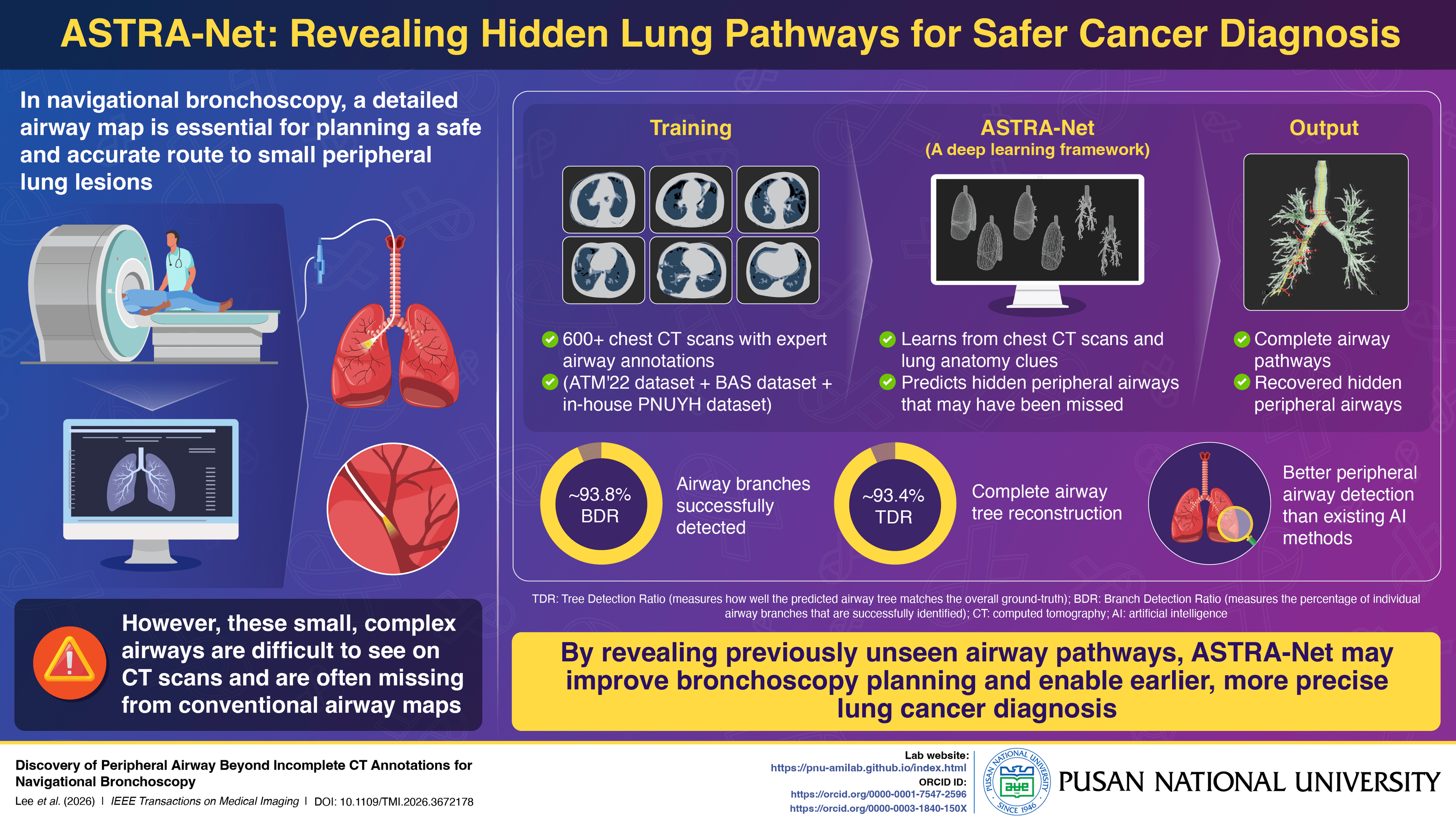
Article Summary
- Researchers at Pusan National University developed ASTRA-Net, an AI framework that uses CT scans to identify peripheral lung airways often missed by standard imaging.
- The tool creates a more complete airway map to help guide bronchoscopy procedures, improving access to hard-to-reach lung tumors.
- The technology could enhance future AI-assisted and robotic bronchoscopy systems, helping address lung cancer, a leading cause of cancer-related deaths.
A university in the Republic of Korea is using artificial intelligence to help doctors detect small lung tumors in areas of the lungs that can be difficult to reach.
Researchers at Pusan National University developed ASTRA-Net, or Anatomical Segmentation with Tree-aware Refinement Attention. The AI framework uses CT scans to identify overlooked peripheral airways, creating a more complete map that can help guide doctors during bronchoscopy.
ASTRA-Net helps identify airways that may have been missed, creating a more accurate roadmap to guide doctors deeper into the lungs.
The researchers said locating small tumors deep within the lungs can be challenging. They developed the tool to help recover peripheral airways that may have been missed in CT scans, giving doctors more options for reaching hard-to-access areas.
CT scans can miss these small and complex airways. Researchers said ASTRA-Net could help address this issue by providing a more detailed view of the lung's airway network and potentially improving how doctors reach difficult-to-access tumors.
Dr. MinWoo Kim, Dr. Hee Yun Seol and other researchers published a paper this year detailing their findings on the medical imaging technology.
“ASTRA-Net is not simply another airway segmentation model. It was specifically designed to identify peripheral airways that may have been overlooked during manual annotation, thereby helping to create a more complete roadmap for bronchoscopy,” Kim said.
ASTRA-Net uses multi-stage deep learning networks to learn the overall structure of the lungs and identify smaller airway branches.
Researchers said the tool showed strong performance in identifying peripheral airways. The model also found that some areas initially labeled as false positives were actually genuine airway branches that had been removed from the original annotations.
“By providing physicians with a more complete airway roadmap, we hope this technology will improve navigation to difficult-to-reach lung lesions and support the development of future AI-assisted and robotic bronchoscopy systems,” Kim said.
Lung cancer is the leading cause of cancer-related deaths worldwide. According to the Roy Castle Lung Cancer Foundation, chest X-rays can miss lung cancer in about one-quarter of cases.
The National Library of Medicine has also reported that lung cancer can be missed by radiologists because identifying and distinguishing structures within the lungs can be challenging. Lung abnormalities can also be overlooked on CT scans due to observer error.
Most lung navigation systems rely on reconstructed CT scans to create a roadmap for doctors. Researchers hope ASTRA-Net can help fill gaps in these existing systems by identifying smaller airways that may otherwise be overlooked.
The researchers said the technology could eventually help doctors navigate to difficult-to-reach lung lesions and support the development of AI-assisted and robotic bronchoscopy systems.
More in AI & Technology

Facebook’s Brief Outage Impacts Thousands of Users Monday Morning
Facebook experienced a brief outage Monday morning, with thousands of users reporting issues accessing the website, app and login features before service was restored.

ASU Launches Bachelor's Degree in Content Creation, Sparking Debate Over Future of Influencer Careers
ASU's new content creation degree aims to prepare students for careers in social media, digital marketing and brand storytelling, but not everyone is convinced a four-year degree is necessary.

Humanoid Robot to Join New York High School Classroom as AI Education Expands
A New York school district is stepping into the future of education by introducing a humanoid AI robot named Sally into a high school classroom this fall.