
Professors Rethinking Testing Amid Growing AI Use
As artificial intelligence becomes more common in higher education, one Brown University professor's experience is highlighting new concerns about academic integrity and how colleges assess student learning.

By Leah Burdick
July 13, 2026

Listen
Listen to this article
Article Summary
- A Brown University professor's take-home midterm had an unusually high average score of 96%, prompting concerns of AI use, while an in-person final resulted in a 48.6% average and many failures.
- A large study found two-thirds of college students use generative AI, with nearly 40% using it monthly and at least 9% using it to cheat, leading experts to recommend new assessment methods.
- Educators caution that AI is a new cheating tool, detection tools are unreliable, and institutions should focus on fostering academic integrity and revising testing approaches.
Article summary generated by AI
A professor at Brown University is raising concerns about the role of artificial intelligence in higher education after a dramatic drop in student exam scores led him to suspect many relied on AI during a take-home midterm.
Professor Roberto Serrano, who teaches economics at Brown University, said he replaced a traditional in-person midterm with a take-home exam after students expressed anxiety about returning to the classroom following a December mass shooting on campus.
When grading the take-home exams, Serrano said he was surprised by the results.
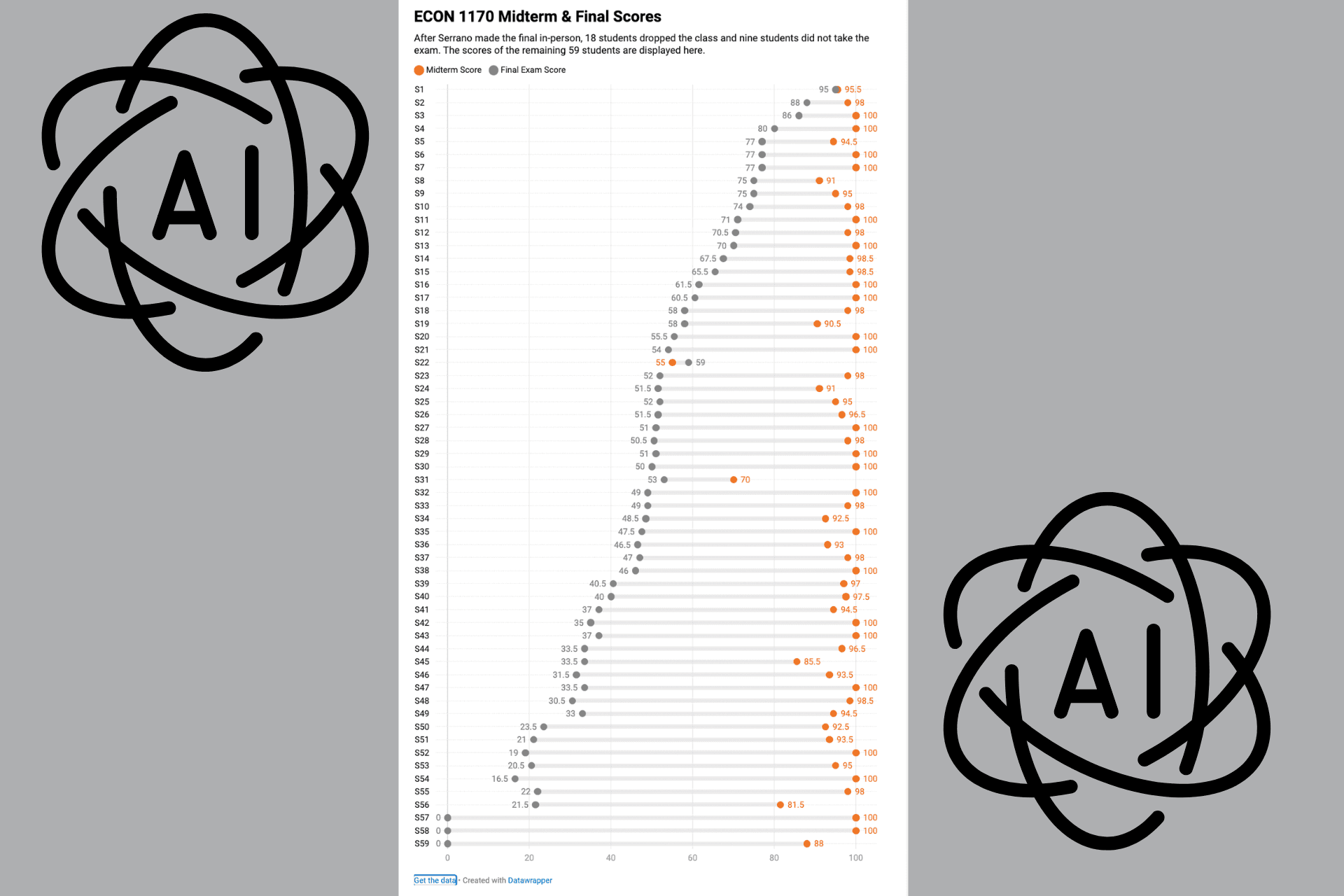
The class earned an average score of 96%, with many students receiving perfect or near-perfect grades. Historically, the average midterm grade in the course has ranged from 65% to 80%, Serrano told Inside Higher Ed. He noted the take-home exam was more difficult than previous midterms because students had unlimited time to complete it.
"Historically the average grade in the midterm of this course has ranged between 65 and 80, and this exam was harder than the exams I wrote in the past, because ... take-home is an opportunity to challenge the class a little bit more, given that you're giving the students unlimited time," Serrano told Inside Higher Ed.
Serrano said he became concerned that some students may have used artificial intelligence to complete the exam after reviewing their responses. He said he compared answers using ChatGPT and believed many appeared to have been AI-generated, though AI tools cannot reliably determine whether text was written by a human or generated by AI.
For the final exam, Serrano returned to an in-person format.
The results were dramatically different. According to Serrano, 18 students dropped the course, nine did not take the final exam and the remaining students earned an average score of 48.6%. Three students received zeroes.
In response, Serrano voided the take-home midterm and made the final exam worth 80% of the course grade. Students who earned at least 40% on the final received passing grades under the revised grading policy, but 19 students ultimately failed the course.
Serrano said he has brought his concerns to Brown University administrators, urging the institution to address the challenges artificial intelligence presents to academic integrity.
AI use among college students
Serrano's concerns reflect a broader trend in higher education as generative AI tools become more common.
The largest study examining undergraduate use of generative AI was led by Igor Chirikov, a senior researcher at the Center for Studies in Higher Education at the University of California, Berkeley.
More than 95,000 students at 20 research-initiative public universities were involved.
In the study about two-thirds of respondents said they used GenAI and almost 40% used it monthly or more, at least 9% of students who used AI reported using it to cheat.
Chirikov said there is no way to ban AI, but professors should find new ways to measure student's knowledge that can't be used with AI.
The research concluded that AI initiatives need more resources and higher prioritization.
AI did not create cheating-- it is a tool
In a paper by Austin Sarat, a professor at Amherst College, he argues that artificial intelligence did not create academic dishonesty but has simply become another tool students can misuse.
In a paper examining academic integrity, Sarat wrote that students cheat for many reasons, including pressure to earn good grades, lack of confidence and poor study habits.
"I don't think of my students as cheaters and I don't want to regard them with the kind of suspicion that turns teaching into a policing activity. But it is my job and that of the college where I teach to recognize that our students need a lot of help to develop good academic habits," Sarat wrote. "Unless colleges acknowledge these facts, I believe they have little chance to curb the pervasiveness of cheating."
AI detection tools professors may use
Companies have developed tools that attempt to identify AI-generated writing, for professors to use while grading students papers and tests.
Turnitin, widely used by schools for plagiarism detection, also offers AI-writing detection. Other tools, including Scribbr and Pangram, claim to identify text generated by platforms such as ChatGPT and Microsoft Copilot. However, researchers and AI developers caution that AI detection tools are not fully reliable and can produce both false positives and false negatives. Because of those limitations, many educators recommend using AI detectors only as one part of a broader review rather than as definitive proof of misconduct.
As AI becomes a permanent part of the classroom, educators will need to balance its benefits with policies that uphold academic integrity and meaningful learning.
More in AI & Technology

AI & Technology
Scottish AI Company Offers Scotch Whisky to Boston Lawyers
Scotland, making its first World Cup appearance in nearly three decades, played two of its three group-stage games at Boston Stadium in Foxborough, Massachusetts.

AI & Technology
'Toy Story 5' Inspires Some Parents to Ditch Tech
While the Toy Story 5 eventually took a more neutral message on the place of technology in childhood, Toy Story 5 prompted some parents to consider making drastic changes in their own homes.
AI & Technology
Aetrex Expands Its Foot Health Technology Into the Next Generation of Athletes
Aetrex is redefining the future of foot health through advanced scanning technology, custom orthotics and strategic partnerships. The company’s latest collaboration with IMG Academy brings its innovation to student-athletes while fueling its continued growth in the world of sports performance.